Wednesday, 22 November 2017

Standard 2 - Graduating Teachers know about learners and how they learn.

2a. have knowledge of a range of relevant theories and research about pedagogy, human development, and learning.

2b. have knowledge of a range of relevant theories, principles, and purposes of assessment and evaluation.

2c. know how to develop ,metacognitive strategies of diverse learners.

2d. know how to select curriculum content appropriate to the learners and the learning context.
As graduating teachers it is important that we have an understanding of theories, pedagogies, assessment tools and strategies to engage and enhance the leanring of all children. By knowing and understanding how tamariki (children) learn, teachers are better able to scaffold and co-construct knowledge based on current and relevant pedagogies (Alton-Lee, 2003).

It is highlighted throughout The New Zealand Early Childhood Curriculum Te Whāriki (1996) the importance of encouraging and supporting children to become creative and abstract thinkers. By developing metacognitive strategies teachers are able to incorporate these strategies into their daily practice ensuring that we are fulfilling our role in creating confident, capable and competent learners (Ministry of Education, 1996).


Evidence 1 - links to 2c

The following pieces of evidence highlights that I understand metacognitive strategies of diverse learners and that I am to articulate and develop strategies. I developed a wall poster for an away practicum centre highlighting metacognition and how to implement in practice. This evidence is also supported by feedback from my Associate teacher (AT).


Evidence 2 - links to 2c

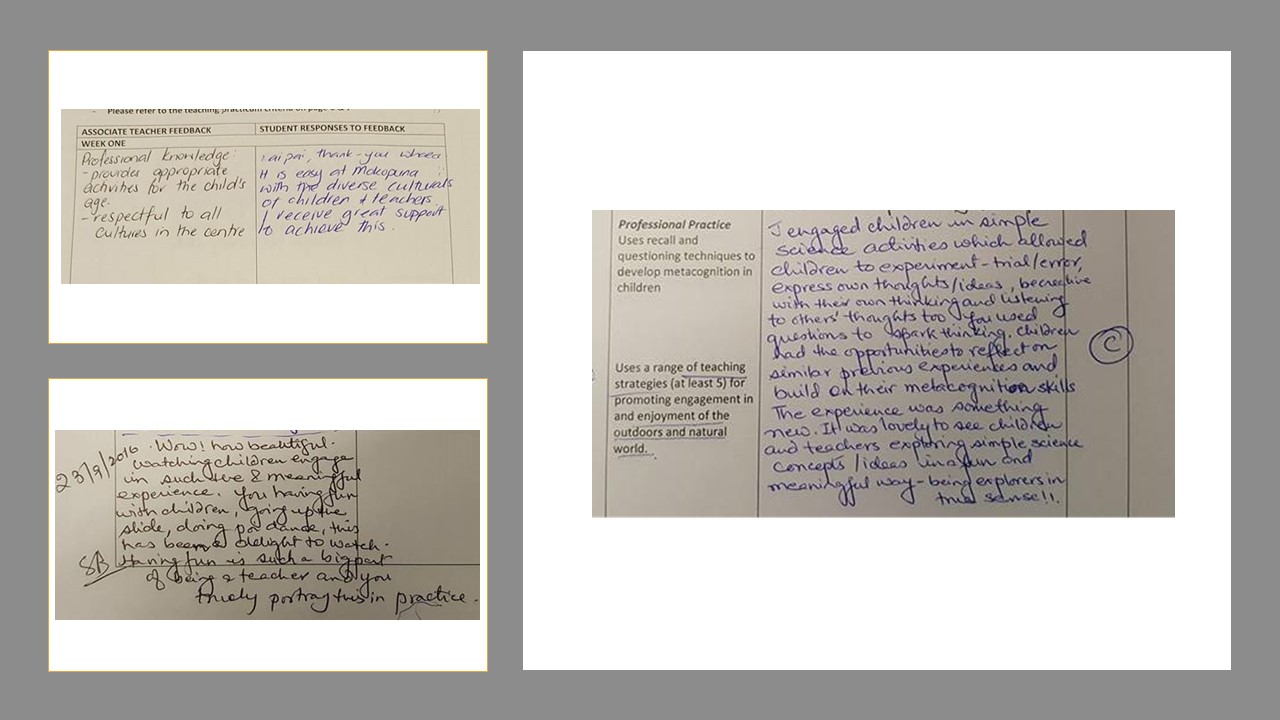
The following evidence is an exert from a planned activity to support metacognitive strategies in my teaching practice. This evidence is also supported by feedback from my AT.
This evidence is further supported by my visiting lecturer and reflected in my marks.


Evidence 3 - links to 2c


The following evidence is VL feedback from a practicum visit which supports I use and develop metacognitive strategies in practice. 


Standard 1 - Graduating Teachers know what to teach.

1a. have content knowledge appropriate to the learners and learning areas of their programme.

1b. have pedagogical content knowledge appropriate to the learners and learning areas of their programme.

1c. have knowledge of the relevant curriculum documents of Aotearoa New Zealand.

1d. have content and pedagogical content knowledge for supporting English as an additional Language (EAL) learners to succeed in the curriculum.


As a graduating early childhood teacher in Aotearoa New Zealand it is vital that I have a sound knowledge and understanding of the content and pedagogical content of early childhood education in Aotearoa. Early childhood education in Aotearoa is underpinned by The New Zealand Early Childhood Curriculum, Te Whāriki (2017). Te Whāriki (2017) is the Ministry of Educations curriculum policy statement and is a framework for providing tamariki (children) early learning and development within a socio-cultural context (Ministry of Education, n.d). Te Whāriki (1996) emphasises the partnership between kaiako (teachers), tamariki, parents and whānau (family). Most importantly Te Whāriki  (2017)  emphasises the cultural heritages of both partners of Te Tiriti o Waitangi which is reflected in the structure and use of English and Te Reo Māori in the text (Ministry of Education, n.d).

It is vital as graduating teachers that we understand what is appropriate for our learners and how best to engage, extend, and support their learning. I firmly believe that play is an important vehicle which children use to explore and make sense of their world. It is our  role to extend children’s play to develop critical and creative thinkers (Guerra & Zuccoli, 2012).  


Evidence 1- links to 1a.

The following piece of evidence is feedback Associate Teachers (AT) which supports I know and understanding what is appropriate for our learners. This supported by photographic evidence.


Evidence 2 - links to 1a, 1b.

The following introduction was written for a child portfolio assessment which demonstrates I have pedagogical and content knowledge relevant to the tamariki I work with. This piece of evidence includes links to constructivist theories of Vygotsky and Piaget (Santrock, 2008). It is essential as teachers we understand the developmental and learning needs of our tamariki to ensure we provide appropriate learning opportunities.


Evidence 3 - links to 1b & 1c.

The following letter was drafted during my studies as a class activity to inform whaanau about Te Whariki (1996). I have since revised this letter and it has now become a part of my home centres welcome pack for new whaanau. This piece of evidence supports I have knowledge of ECE curriculum documents.